Jan 6, 2026

IMEC (India-Middle East-Europe Economic Corridor)
IMEC (India-Middle East-Europe Economic Corridor)

The India-Middle East-Europe Economic Corridor (IMEC) is a multi-modal transit project launched at the 2023 G20 Summit. It aims to create a reliable and cost-effective trade route connecting India to Europe through the Arabian Peninsula, serving as a strategic alternative to traditional maritime routes and China's Belt and Road Initiative.

Short Description

The project is divided into two main segments:

  • East Corridor: A maritime shipping route connecting Indian ports (like Mumbai and Mundra) to the United Arab Emirates (UAE).

  • Northern Corridor: A high-speed railway network (the "Rail Project" backbone) and maritime link connecting the UAE to Europe via Saudi Arabia, Jordan, and Israel.

Key Features:

  • Efficiency: Estimated to reduce transit times by 40% and logistics costs by 30% compared to the Suez Canal route.

  • Multidimensional: Beyond rail and shipping, it includes undersea data cables, electricity grids, and pipelines for clean hydrogen.

  • Strategic Partners: Backed by India, the US, UAE, Saudi Arabia, the EU, France, Germany, and Italy.

IMEC Route Map Overview

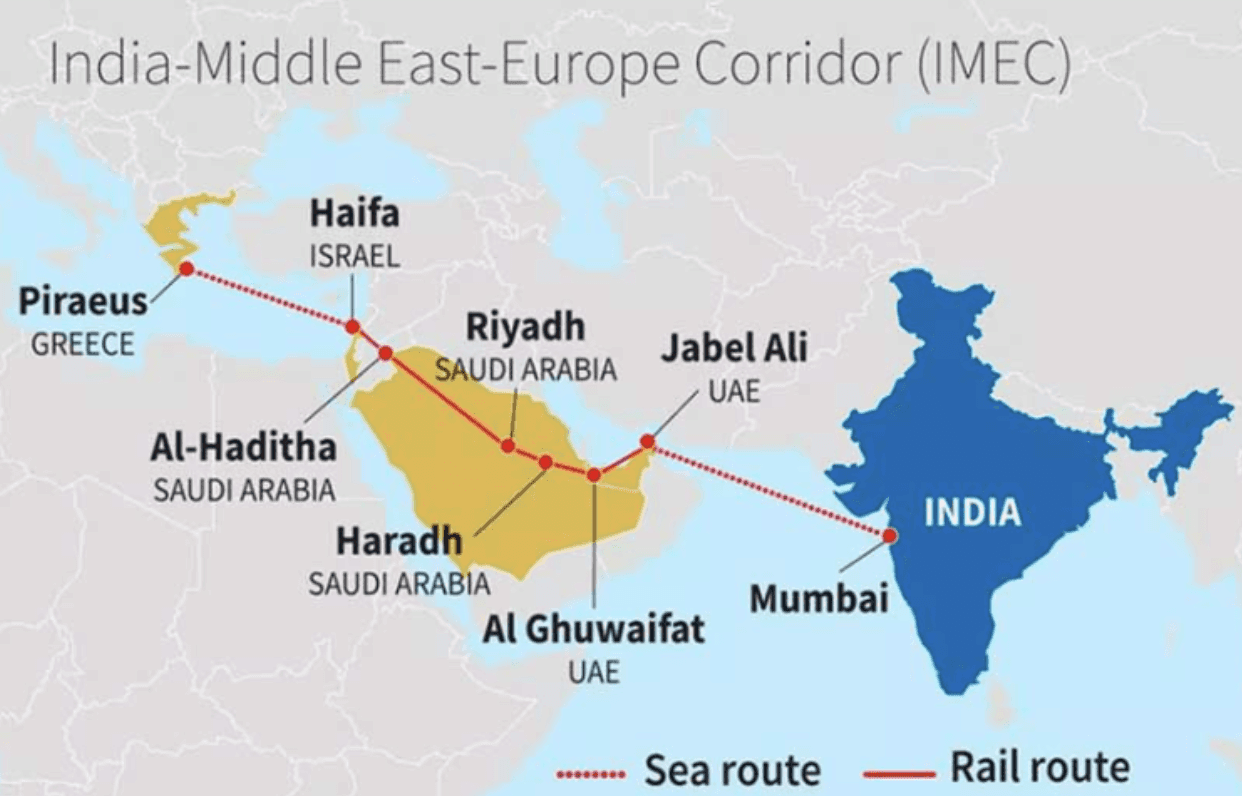
The corridor links several critical hubs across three regions. Below is a map view highlighting the major nodes and the path of the proposed rail and sea links.

  • India: Mumbai and Mundra (Primary Sea Ports)

  • UAE: Fujairah and Jebel Ali (Ports transitioning to Rail)

  • Saudi Arabia: Al Ghuwaifat and Haradh (Railway hubs)

  • Israel: Port of Haifa (Rail terminal to Sea)

  • Europe: Piraeus, Greece (Primary European Entry Port)

The India-Middle East-Europe Economic Corridor (IMEC) is a multi-modal transit project launched at the 2023 G20 Summit. It aims to create a reliable and cost-effective trade route connecting India to Europe through the Arabian Peninsula, serving as a strategic alternative to traditional maritime routes and China's Belt and Road Initiative.

Short Description

The project is divided into two main segments:

  • East Corridor: A maritime shipping route connecting Indian ports (like Mumbai and Mundra) to the United Arab Emirates (UAE).

  • Northern Corridor: A high-speed railway network (the "Rail Project" backbone) and maritime link connecting the UAE to Europe via Saudi Arabia, Jordan, and Israel.

Key Features:

  • Efficiency: Estimated to reduce transit times by 40% and logistics costs by 30% compared to the Suez Canal route.

  • Multidimensional: Beyond rail and shipping, it includes undersea data cables, electricity grids, and pipelines for clean hydrogen.

  • Strategic Partners: Backed by India, the US, UAE, Saudi Arabia, the EU, France, Germany, and Italy.

IMEC Route Map Overview

The corridor links several critical hubs across three regions. Below is a map view highlighting the major nodes and the path of the proposed rail and sea links.

  • India: Mumbai and Mundra (Primary Sea Ports)

  • UAE: Fujairah and Jebel Ali (Ports transitioning to Rail)

  • Saudi Arabia: Al Ghuwaifat and Haradh (Railway hubs)

  • Israel: Port of Haifa (Rail terminal to Sea)

  • Europe: Piraeus, Greece (Primary European Entry Port)