The Belt and Road Initiative (BRI)
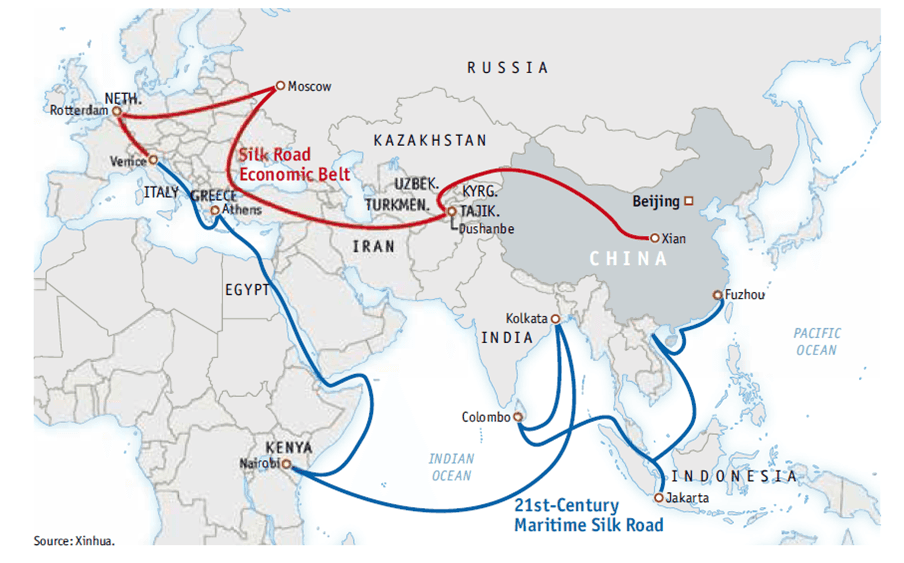
The Belt and Road Initiative (BRI), originally known as One Belt One Road (OBOR), is a massive global infrastructure development strategy adopted by the Chinese government in 2013. Its goal is to invest in nearly 150 countries and international organizations to enhance regional connectivity and trade.
The project consists of two main components:
The Silk Road Economic Belt: A land-based route connecting China to Central Asia, Europe, and the Middle East through a network of railways, roads, and pipelines.
The 21st Century Maritime Silk Road: A sea-based route linking China’s coast to Southeast Asia, South Asia, Africa, and the Mediterranean through the development of ports and maritime trade hubs.
The initiative aims to stimulate economic growth, improve trade links, and expand China's global influence through large-scale investments in transportation, energy, and digital infrastructure.
The rail component of the Belt and Road Initiative, often called the "Iron Silk Road," is a central pillar of the Silk Road Economic Belt. It focuses on creating a high-speed, high-capacity land link between China, Southeast Asia, Central Asia, and Europe.
Here are the key details regarding the BRI rail network:
1. China-Europe Railway Express (CR Express)
This is the most famous part of the rail project. It consists of a network of long-distance freight trains connecting dozens of Chinese cities (like Chongqing, Chengdu, and Xi'an) to major European hubs (like Duisburg, Germany; Madrid, Spain; and London, UK).
Speed vs. Cost: Rail is the "middle ground" of logistics. It is much faster than sea freight (taking 12–18 days compared to 30–45 days by ship) and significantly cheaper than air freight.
Key Corridors: There are three main routes: the Western corridor (via Kazakhstan), the Central corridor (via Mongolia), and the Eastern corridor (via the Russian Far East).
2. The Trans-Asian Railway (Southward Expansion)
China is investing heavily in connecting its southern provinces to Southeast Asia.
China-Laos Railway: Opened in 2021, this $6 billion project connects Kunming to Vientiane, turning Laos from a "land-locked" to a "land-linked" country.
Pan-Asia Railway Network: Plans are underway to extend these lines through Thailand and Malaysia, eventually reaching Singapore.
3. Regional Corridors
China-Pakistan Economic Corridor (CPEC): Includes plans to upgrade the ML-1 railway line, which would link the port of Gwadar in the south to the Chinese border in the north.
Central Asia Links: Extensive upgrades to railways in Kazakhstan and Uzbekistan to facilitate the transit of goods between the East and West.
4. Technical and Strategic Challenges
Gauge Differences: One of the biggest hurdles is that different countries use different rail gauges. China and Europe use "standard gauge," but Russia and former Soviet states use "broad gauge." This requires time-consuming transfers of containers at borders.
Geopolitics: Recent conflicts (such as the war in Ukraine) have disrupted the Northern Corridor through Russia, forcing many logistics companies to look toward the "Middle Corridor" which crosses the Caspian Sea.