The INSTC Corridor Russia to Indian Ocean
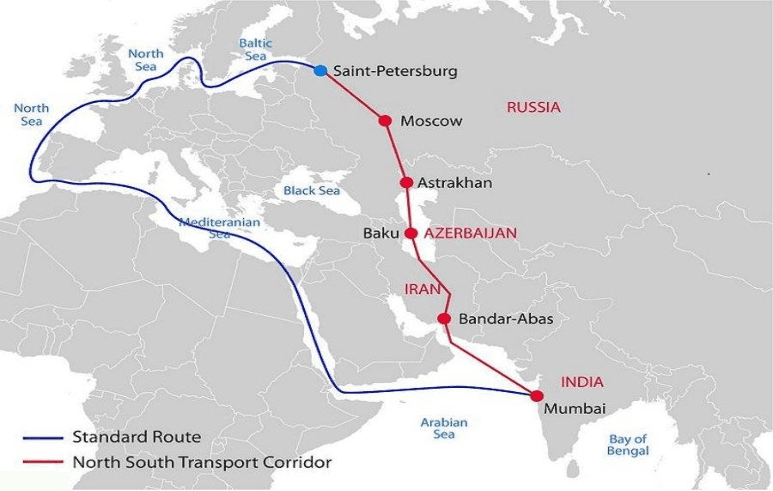
🛤️ The Three Main Rail Branches
The "Rail Corridor" isn't a single track but a series of routes that utilize existing and newly built rail networks across several nations.
Route | Primary Path | Description & Status |
Western Route | Russia → Azerbaijan → Iran | The most direct rail-to-rail link. It connects St. Petersburg to Mumbai via the Iranian port of Bandar Abbas. |
Eastern Route | Russia → Kazakhstan → Turkmenistan → Iran | Connects Russia directly to the Persian Gulf via Central Asia. It became fully operational for freight in 2022. |
Trans-Caspian | Russia → Caspian Sea → Iran | A multimodal path involving rail transport to Caspian ports (like Astrakhan or Mahachkala), then shipping across the sea to Iranian ports (Anzali/Amirabad). |
🛠️ Key Technical Details & The "Missing Link"
For the corridor to be a "seamless" rail journey, one specific section has been the focus of international attention:
The Rasht-Astara Link (164 km): This is the final "missing link" of the Western Route.3 Located in northern Iran, it connects the Iranian rail grid to the Azerbaijani border.4
Progress (2025-2026): In early 2025, Russia and Iran signed a final roadmap to accelerate construction, with major work beginning in March 2025.5 Completion is expected to allow uninterrupted rail transit from St. Petersburg to the Persian Gulf.
The Chabahar-Zahedan Link: India is heavily invested in connecting the Chabahar Port to the Iranian rail network via Zahedan.6 As of early 2026, this link is nearing commissioning, which will allow India to bypass the Strait of Hormuz for Central Asian trade.
📊 Benefits & Efficiency
The INSTC is designed to be a "game-changer" for Eurasian logistics compared to the Suez Canal:7
Time Reduction: Reduces transit time from 45-60 days (Suez) to approximately 18-25 days.8
Cost Savings: Estimated to be 30% cheaper in freight costs.9
Geopolitical Bypass: Allows India to bypass Pakistan to reach Central Asia and provides Russia with a "sanction-resilient" route to warm-water ports.10
🌍 Member Countries
Originally founded by India, Iran, and Russia, the corridor now includes:
Members: Azerbaijan, Armenia, Kazakhstan, Kyrgyzstan, Tajikistan, Turkey, Ukraine, Belarus, Oman, and Syria.11
Observer: Bulgaria.12
To understand the impact of the International North-South Transport Corridor (INSTC), we can focus on Azerbaijan, which serves as the central "bridge" of the Western Route.
As of early 2026, Azerbaijan has transitioned from the planning phase to being a high-functioning logistics hub. Its portion of the route is critical because it connects the Russian rail grid directly to the Iranian border.
🇦🇿 Azerbaijan’s Key Infrastructure Projects
Azerbaijan’s rail segment spans approximately 511 km, running from the Russian border (Yalama) to the Iranian border (Astara).
1. The Sumgayit–Yalama Line Modernization
Completed in late 2025, this was a massive reconstruction of the northern segment of the corridor.
Scale: Over 330 km of track was upgraded, including 13 stations and 572 engineering structures.
Impact: This modernization allows for higher train speeds and increased safety, significantly reducing "bottlenecks" that previously existed near the Russian border.
2. The Astara Cargo Terminal
Located right on the border with Iran, this terminal is the primary transshipment point where goods shift between Azerbaijani and Iranian systems.
Status (2026): Construction of the expanded terminal is scheduled for full completion in Q1 2026.
Capacity: It is designed to handle the initial surge of cargo as the corridor aims for a target of 5 million tons of freight annually by 2028.
🚀 Recent Developments (January 2026)
Digital Integration: In early 2026, Azerbaijan and Russia implemented new e-data exchange agreements. This allows for "paperless" customs, meaning freight trains spend hours rather than days at the border.
Trilateral Cooperation: A recent memorandum between Azerbaijan, Russia, and Iran has unified rail tariffs. This means a single shipping price can be quoted for the entire journey from Moscow to the Persian Gulf, making it commercially competitive with sea routes.
The "Middle Corridor" Synergy: Azerbaijan is strategically using the same infrastructure to support the Middle Corridor (connecting China to Europe). This "dual-use" strategy makes Azerbaijan the most important transit point in Eurasia today.
📉 Transit Efficiency Comparison
Azerbaijan’s investment has made the Western Route the most attractive branch of the INSTC.
Feature | Via Azerbaijan (INSTC) | Traditional Suez Route |
Travel Time | 18–25 Days | 45–60 Days |
Distance | ~7,200 km | ~16,000 km |
Primary Mode | Rail / Multi-modal | Sea / Container Ship |
Summary: Azerbaijan is currently the most "ready" participant. While the world waits for Iran to finish the Rasht-Astara link (expected by 2028), Azerbaijan has already completed its internal homework, modernizing its tracks and digitizing its customs to handle the massive shift in global trade.
Would you like to see a breakdown of the "Eastern Route" through Kazakhstan and Turkmenistan, or perhaps more details on the "Middle Corridor" that also passes through Azerbaijan?
As of early 2026, the Eastern Route of the INSTC has become the most "ready-to-use" alternative for rail freight, largely because it avoids the unfinished rail sections found in the Western Route.
🇰🇿 🇹🇲 The Eastern Route: Kazakhstan & Turkmenistan
This route runs along the eastern coast of the Caspian Sea and is essentially a 900+ km railway line often referred to as the KTI (Kazakhstan-Turkmenistan-Iran) Corridor.
1. The Logistics Backbone
The route connects Uzen (Kazakhstan) to Bereket (Turkmenistan) and enters Iran at Incheh Borun.
Operational Status: Unlike the Western route, the KTI rail link is 100% physically connected. In 2025, container traffic on this branch nearly doubled due to aggressive tariff discounts (up to 40% off) provided by the three nations.
The "Aprin" Milestone: In November 2025, a landmark cargo train from north of Moscow reached the Aprin Dry Port near Tehran in just 12 days via this route.
2. Turkmenistan’s Strategic Shift
Turkmenistan, once a neutral observer, officially joined the INSTC agreement in 2023-2024.
The Sarakhs Crossing: This has become a major hub. Goods from Russia and Kazakhstan are transshipped here between Soviet-gauge (1520mm) and Iranian-gauge (1435mm) tracks.
Modernization: Russia is currently funding the modernization of Turkmenistan's internal rail logistics to ensure that trains don't lose time during border inspections.
⚡ INSTC vs. The "Middle Corridor" (TITR)
Since you asked about specific portions, it is helpful to see how this North-South axis compares to the East-West Middle Corridor, which also passes through Kazakhstan and Azerbaijan.
Feature | INSTC (Eastern Route) | Middle Corridor (TITR) |
Direction | North-South (Russia to India) | East-West (China to Europe) |
Key Player | Russia / Iran / Kazakhstan | China / Azerbaijan / Turkey |
Main Advantage | 30% cheaper than Suez Canal | Bypasses sanctioned Russian territory |
Current Volume | ~27 Million Tons (2025) | ~6-10 Million Tons (2025) |
💎 Why the Eastern Route is Winning in 2026
Sanction Resilience: For Russia and India, this route is the safest way to trade without Western interference.
Speed: It is currently the fastest land route to the Persian Gulf. A shipment from the Baltic Sea to Mumbai now takes 15–18 days via this branch, compared to 45+ days by sea.
Energy Trade: Central Asian countries are now using this rail corridor to export minerals and grain directly to the Indian Ocean, bypassing the need for expensive Black Sea ports.
Current Trend: In January 2026, the first "Green Corridor" agreement was signed, digitizing all customs documents between Kazakhstan and Iran, reducing border wait times from 2 days to 4 hours.
Would you like me to explain the "Trans-Caspian" (Sea) route, or perhaps provide more detail on the specific rail gauges and technical challenges of crossing these borders?