The Iraq-Türkiye Development Road
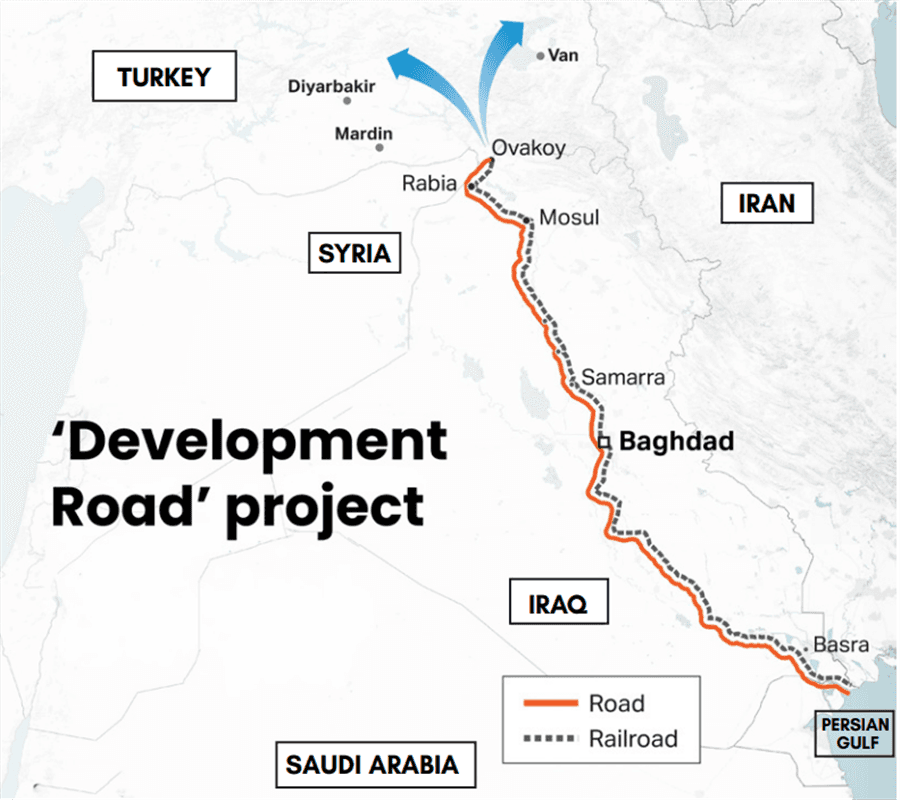
The Iraq-Türkiye Development Road (also known as the "Dry Canal") is a massive $17 billion infrastructure project designed to create a direct trade corridor between the Persian Gulf and Europe.
Often viewed as a competitor to the Suez Canal, it aims to reduce travel time between Asia and Europe by about 15 days.
Key Components
The Starting Point: The project begins at the Grand Faw Port in Basra (southern Iraq), which is set to become the largest container port in the Middle East.
The Rail Link: A 1,200 km (745-mile) high-speed railway designed for both passengers (up to 300 km/h) and freight (up to 150 km/h).
The Motorway: A parallel modern highway for cargo trucks.
Strategic Hubs: The route includes the construction of 15 stations and several industrial zones along the corridor to stimulate local economies.
The Route
The corridor spans the entire length of Iraq from south to north, passing through these major hubs:
Basra (Grand Faw Port)
Nasiriyah
Najaf & Karbala
Baghdad
Mosul
Faysh Khabur (The border crossing into Türkiye)
Türkiye: Connects to the Turkish rail/road network via Gaziantep and Mersin, eventually reaching Istanbul and Europe.
Timeline & Status (as of 2026)
Partnership: A quadrilateral agreement was signed in 2024 between Iraq, Türkiye, Qatar, and the UAE, with the Gulf nations providing significant financial backing.
Phased Completion: The first phase is expected to be operational by 2028-2029, with subsequent expansions planned through 2033 and 2050.
Current Progress: As of early 2026, major work on the Grand Faw Port berths is nearing completion, and construction tenders for the primary rail segments have been awarded.
Technical detail and Figures:
The Iraq-Türkiye Development Road is a massive multimodal logistics corridor designed to transform Iraq from a rentier economy into a global transit hub. As of early 2026, the project has moved into high gear with significant progress in both design and early-stage construction.
1. Financial Investment & Economic Impact
Total Estimated Cost: $17 billion to $20 billion.
$10.5 billion allocated for the high-speed railway and rolling stock.
$6.5 billion for highway construction and supporting industrial zones.
Revenue Generation: Projected to generate $4 billion to $5 billion annually in transit fees and services.
Job Creation: Estimated to create 100,000 jobs during construction, rising to over 1 million once fully operational.
2. The Railway (The "Iron Backbone")
The rail system is designed as a dual-track, high-speed network for both passengers and freight, intended to meet the highest international standards.
Feature | Technical Specification |
|---|---|
Total Length | 1,176 km to 1,200 km |
Design Speed (Passenger) | 300 km/h (High-Speed Rail) |
Design Speed (Freight) | 120 km/h – 150 km/h |
Capacity (Initial) | 3.5 million containers (TEU) & 22 million tons of bulk cargo/year |
Capacity (Final Phase) | 7.5 million containers (TEU) & 33 million tons/year |
Passenger Volume | 13.8 million to 15 million passengers annually |
Major Hubs | 15 stations across 11 Iraqi provinces (Basra, Baghdad, Mosul, etc.) |
3. The Grand Faw Port (The Anchor)
Located in Basra, this port is the entry point for all cargo coming from Asia (China, India, UAE).
Size: Projected to be the largest port in the Middle East, with a 90-berth capacity (surpassing Dubai’s Jebel Ali).
Status 2026: Three of the five main sections are already completed. The submerged tunnel connecting it to Umm Qasr is roughly 80% complete.
Operational Goal: Expected to receive its first commercial freighter in late 2025/early 2026.
4. The Highway Corridor
Parallel to the railway, a modern 1,190 km motorway will handle heavy-duty cargo trucks.
Design: Multilane highway designed for high-tonnage freight.
TIR System: Iraq recently joined the TIR (Transports Internationaux Routiers) system, which allows for sealed trucks to cross borders with minimal customs interference, drastically speeding up transit to Türkiye and Europe.
5. Implementation Phases
Phase 1 (By 2028-2029): Core link from Basra to Baghdad and the Turkish border; port fully operational.
Phase 2 (By 2033): Expansion of container capacity and integration of industrial cities along the route.
Phase 3 (By 2050): Full dualization of all segments and maximum cargo/passenger throughput.
As of early 2026, the Iraq-Türkiye Development Road has transitioned from the design phase into active construction. The project is managed by a coalition of international engineering giants and financial consultants.
1. Key Engineering & Design Players
The project is divided into several specialized contracts, with European and Asian firms leading the technical execution:
PEG Infrastructure (Italy): The lead technical consultant responsible for the master plan, feasibility studies, and detailed engineering designs for the entire 1,200 km rail and highway network.
BTP Infrastrutture (Italy): Heavily involved in the technical designs and field studies. As of late 2025, they have completed roughly 75% of the field surveys, including geological and topographic mapping.
Alstom (France): Shortlisted and primarily expected to handle the railway implementation, including the supply of high-speed rolling stock (trains) and signaling systems.
Daewoo E&C (South Korea): The primary contractor for the Grand Faw Port infrastructure. They recently handed over the first five major container berths to the Iraqi government (late 2024/2025) and are building the critical submerged tunnel.
Oliver Wyman (USA): Appointed as the financial and economic consultant to develop the project’s investment model and help market it to international private investors.
2. Technical Infrastructure Figures
The "Development Road" is designed to handle massive throughput to rival maritime routes like the Suez Canal.
The Railway System
Track Type: Dual-track, standard gauge, electrified.
Rolling Stock: High-speed electric trains for passengers; heavy-haul freight locomotives.
Interoperability: Designed to eventually connect with Türkiye’s high-speed network at the Ovaköy/Fishkhabur border.
Project Capacity & Speed
Category | Technical Figure |
|---|---|
Total Track Length | 1,176 km |
Passenger Train Speed | 300 km/h |
Freight Train Speed | 140–160 km/h |
Daily Train Capacity | ~80–90 trains per day |
Initial Container Capacity | 3.5 million TEU per year |
Phase 2 Container Capacity | 7.5 million TEU per year (by 2038) |
3. Construction Status (2026 Update)
Grand Faw Port: The first phase is nearly operational. The 2.4 km submerged tunnel (the "Silk Tunnel") under the Khor Al-Zubair channel is over 80% complete.
Rail Corridors: Earthworks and soil stabilization have begun in the southern segments between Basra and Nasiriyah.
Digital Integration: Iraq has signed agreements with Türk Telekom to lay a fiber-optic "digital corridor" alongside the railway, providing ultra-fast data links between the Gulf and Europe.
4. Strategic Geopolitical Backing
In 2024, a Quadrilateral Memorandum of Understanding was signed by:
Iraq: The host and primary financier.
Türkiye: The gateway to Europe.
UAE & Qatar: Leading the investment and providing logistical expertise (ports and free zones).